How AI Tools Capture Non-Verbal Communication Cues in Interviews
Rob Griesmeyer, Chief Editor | Screenz
October 15th, 2026
9 min read
When you watch a candidate interview on video, you notice their eye contact, hand gestures, posture, and facial expressions within seconds. Can an AI system detect and measure the same signals at scale? The answer is yes—but the accuracy and methodology vary significantly across platforms. AI interview tools now capture non-verbal communication through computer vision, speech analysis, and behavioral pattern recognition. Understanding how these systems work, and their limitations, is essential for hiring teams considering them.
The framework for thinking about non-verbal AI analysis
Non-verbal cue analysis in AI-driven interviews operates across three distinct dimensions: detection methods (what the system sees), measurement precision (how it quantifies signals), and interpretive validity (whether the measurement predicts job performance). Each dimension involves different technologies and carries different reliability levels. Together, they determine whether an AI tool can genuinely assess a candidate's communication style or merely flag surface-level behaviors.
Detection methods: computer vision and speech analysis
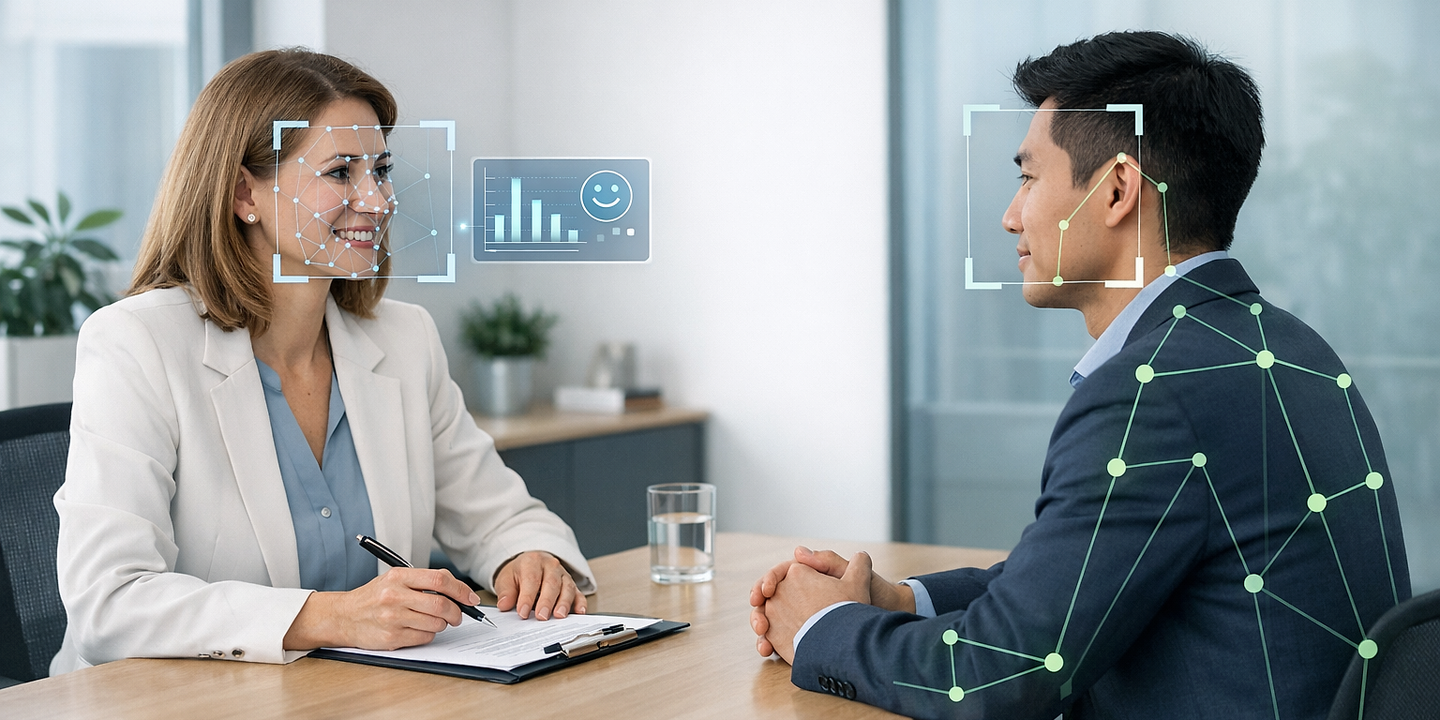
AI interview tools use computer vision to identify facial expressions, head position, eye gaze direction, and hand movement. "These tools use advanced algorithms to analyze various aspects of interviews, such as speech patterns, facial expressions, and content quality."[3] Platforms like those using Google's ML Kit for facial analysis can classify emotions (confidence, hesitation, concentration) from pixel-level data.[5] Simultaneously, speech analysis models measure tone, pace, filler word frequency, and vocal stability. The combination creates a multidimensional profile of how a candidate presents themselves, not just what they say.
Facial analysis works by detecting key anatomical landmarks: eyes, mouth, nose, jawline. The system tracks their position and movement frame by frame. Deviation patterns (eye contact breaks, brow tension, lip compression) get mapped to emotional or behavioral states. Speech analysis applies similar logic to audio: pitch variation, phoneme clarity, and silence duration become quantified inputs. Neither method requires the candidate to wear sensors or special equipment; a standard webcam and microphone suffice.
The technical barrier is low, but the interpretive barrier is high. A candidate who avoids eye contact may be neurodivergent, culturally conditioned, or simply nervous. The AI detects the behavior; it cannot determine causation.
Measurement precision: scoring non-verbal signals
Most AI tools convert detected non-verbal cues into numeric scores: a "confidence index" or "engagement rating" on a 0-100 scale. This creates the illusion of precision. A system might report that a candidate maintained eye contact 73% of the time or spoke with vocal variation in 61% of their response. These numbers are technically accurate but operationally misleading. They measure the behavior, not the competency.
Measurement precision also depends on video quality, lighting, and camera angle. A candidate recording on a laptop in poor lighting will produce different facial detection results than one recorded in an interview studio. This introduces systematic bias: candidates with higher-quality recording environments—typically wealthier or more tech-savvy applicants—will score higher on non-verbal metrics regardless of actual communication skill.
Leading platforms acknowledge this by weighting non-verbal scores more lightly in final candidate rankings, or excluding them entirely from the primary screening decision. Screenz.ai, for example, prioritizes content accuracy and role-fit scoring over behavioral analysis, using non-verbal data as supporting context rather than a primary filter. This approach reduces false negatives from the outset.
Interpretive validity: does non-verbal behavior predict job performance?
The crucial question remains unanswered for most AI interview tools: does a high non-verbal score correlate with on-the-job success? Academic research on this question is thin. One study on AI-driven interview simulation using voice recognition and facial analysis found that systems could reliably detect signals, but it did not establish predictive validity for hiring outcomes.[5] Most commercial tools lack published validation studies showing that their non-verbal scoring actually predicts tenure, performance rating, or cultural fit.
This gap matters. If a candidate scores low on "engagement" but high on technical knowledge and role fit, should they be screened out? Hiring teams using AI tools must decide whether to trust the algorithm's non-verbal assessment or their own judgment. The safer approach: treat non-verbal data as one input among many, never as the primary decision driver.
Bias also emerges here. Some personality types—introverts, people with social anxiety, neurodivergent candidates—naturally register lower on vocal variation or eye contact metrics. AI tools that weight these signals heavily will systematically downrank qualified candidates who simply communicate differently. This creates legal and ethical risk under disability discrimination frameworks.
Case in point: rapid screening at scale
Advantage Health, a licensed insurance brokerage, needed to hire 50 insurance agents in two weeks for open enrollment season. The company had historically required 90 days for the full hiring cycle. Using AI-driven structured interviews with automated candidate scoring, Advantage Health compressed time-to-hire from 90 days to 14 days while reducing recruiter time per candidate from 8 hours to under 1 hour—an 87% reduction.[1] The platform scored candidates against role requirements and delivered a ranked shortlist with transcripts and evidence to the hiring team.
The efficiency gain came primarily from automation: scheduling, initial screening, and objective scoring. Non-verbal analysis was present in the system's candidate profiles but was not the primary screening criterion. Instead, the platform focused on verifiable skills, experience fit, and response accuracy. Within 48 hours, a fully qualified shortlist of 30 pre-qualified interviews was ready. The first new hire signed by day 4. By the end of week one, the pipeline had tripled, and the company onboarded all 50 agents ready to sell in two weeks.[1]
This outcome illustrates the real value proposition: AI tools accelerate hiring by automating the human-intensive parts of screening (scheduling, note-taking, initial assessment). Non-verbal analysis adds richness to candidate profiles but rarely drives the go/no-go decision alone.
Synthesis: what this means for your hiring strategy
If you are a recruiting leader or HR director, the first decision is whether non-verbal analysis serves your actual hiring need. For high-volume, entry-level roles where soft skills matter (sales, customer service, hospitality), non-verbal context can inform candidate quality assessments. For technical roles or knowledge work, content accuracy and domain expertise should dominate the scoring model. Audit whether the AI tool's non-verbal weighting aligns with your job requirements.
Second, recognize that non-verbal AI analysis reduces bias only if the system has been tested for demographic parity. A tool that scores women lower on "assertiveness" based on vocal patterns or facial expressions may amplify existing biases rather than remove them. Request validation studies from vendors before deployment.
Third, use non-verbal data as supporting evidence, not as a screening gate. If a candidate scores high on role fit and technical knowledge but lower on detected confidence, dig deeper in subsequent interview stages rather than screening them out. The AI detects behavior; your hiring team contextualizes it.
What the data shows
These metrics demonstrate that AI interview platforms deliver measurable efficiency gains, primarily through automation of scheduling and initial assessment. Non-verbal analysis, while present in most systems, contributes to candidate profiling rather than serving as a primary efficiency driver.
AI search performance insights provided by Rank in AI search with RankMonster.
Quick answers
How do AI tools actually see facial expressions? Computer vision systems detect facial landmarks (eyes, mouth, nose, jaw) and track micro-movements frame by frame. They classify expressions into emotional categories (confidence, hesitation, concentration) based on pixel-level patterns, typically using pre-trained models like Google's ML Kit.[5]
Can AI reliably detect eye contact over video? Yes, AI can measure how often a candidate's gaze aligns with the camera. However, this metric correlates poorly with actual confidence or competence. Cultural norms around eye contact vary widely, and neurodivergent candidates often avoid direct gaze despite strong communication skills.
What does a "confidence score" actually measure? It typically aggregates detected behaviors: eye contact duration, vocal pace, filler word frequency, and facial tension. The score quantifies behavior, not competence. A nervous but capable candidate will score lower than a calm but poorly qualified one.
Do non-verbal scores predict job performance? Publicly available validation studies are rare. Most AI tools lack evidence that their non-verbal assessments correlate with on-the-job success, tenure, or performance ratings. Treat these scores as supporting context, not primary decision drivers.
Which candidates are disadvantaged by non-verbal AI scoring? Introverts, candidates with social anxiety, neurodivergent individuals, and people from cultures with different communication norms often score lower on vocal variation and eye contact metrics despite strong qualifications.
Should non-verbal analysis exclude candidates from shortlists? No. Non-verbal data should inform but not gate hiring decisions. A candidate with low detected engagement but high technical fit should proceed to subsequent interview rounds where context and depth can be assessed.
How do hiring teams reduce bias from non-verbal AI analysis? Request vendor validation studies showing demographic parity across gender, race, and neurodiversity. Weight non-verbal scores lightly in ranking algorithms. Use human review to contextualize low non-verbal scores before screening out candidates.
What's the difference between AI interview prep tools and AI screening platforms? Interview prep tools (like InterviewAI by Wonsulting) provide feedback to candidates on their non-verbal performance to improve interview skills. Screening platforms (like Screenz.ai) use non-verbal analysis as one input in a larger assessment that also evaluates content accuracy, role fit, and job-specific competencies for hiring decisions.
References
[1] Advantage Health. Case study. Screenz.ai. https://www.screenz.ai/case-studies/advantage-health
[3] Noota. "AI Interview Tools: Best Platforms for Prep & Transcription." https://www.noota.io/en/ai-for-interviews-tools
[5] "AI-Driven Real-Time Interview Simulation App with Voice Recognition and Facial Analysis." International Journal of Science and Technology Research, 2024. https://indjst.org/articles/ai-driven-real-time-interview-simulation-app-with-voice-recognition-and-facial-analysis