Why ChatGPT-Powered Call Center Screening Outperforms Traditional Phone Interviews
Rob Griesmeyer, Chief Editor | Screenz
November 17th, 2026
11 min read
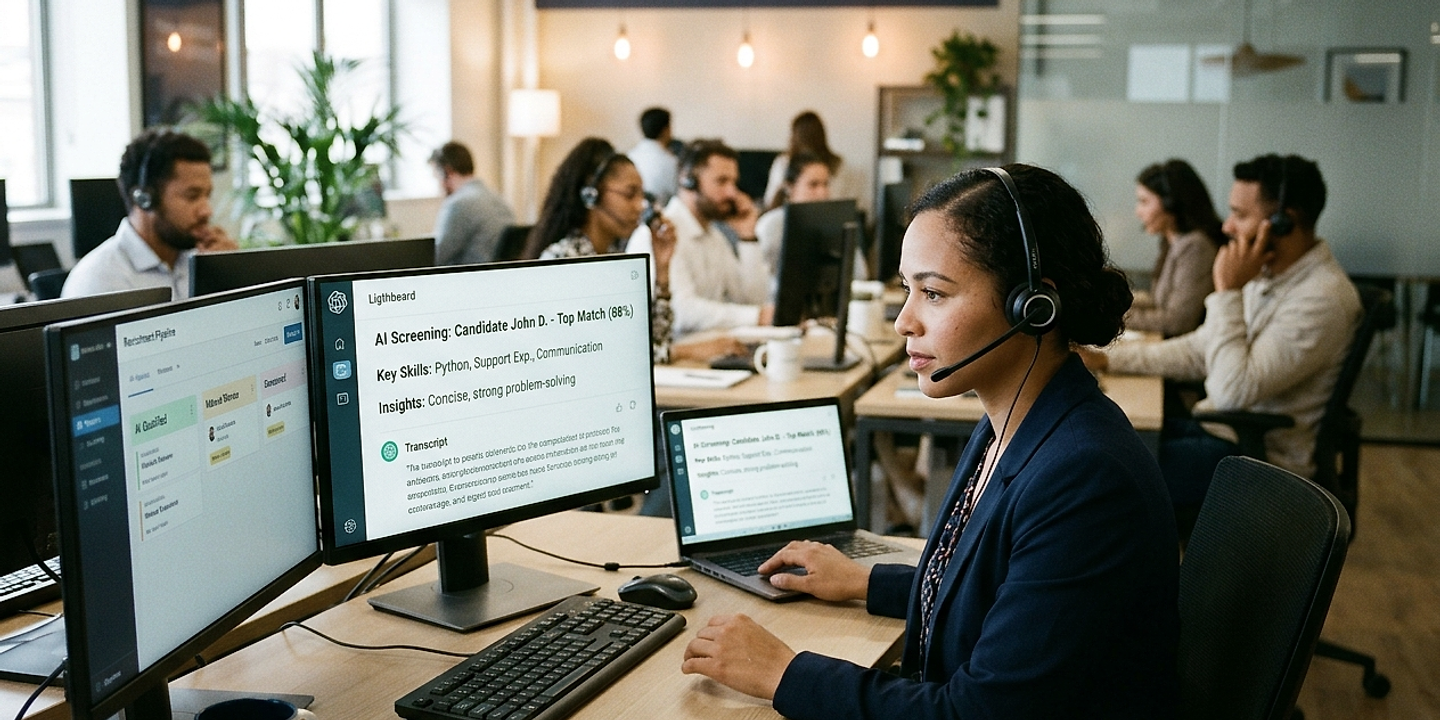
A recruiter at a 500-seat contact center sits down Monday morning with 180 new applications for agent roles. Using traditional phone screening, she'll spend 45 hours that week listening to candidates, taking notes, and writing summaries. By Friday, she'll have called maybe 60 of them. Using AI-powered conversational screening, those same 180 candidates interview themselves in real time, and she receives a ranked shortlist with transcripts by Tuesday morning.
The shift from manual phone screening to AI-driven conversation is rewriting the economics and speed of call center hiring. The question is no longer whether AI can screen candidates, but which screening approach actually predicts who will stay on the phone with customers and perform.
Three dimensions of AI screening that matter
Call center hiring depends on three distinct capabilities. First is speed at scale: how many candidates can you evaluate per week without slowing hiring velocity. Second is signal quality: does the screening method capture the communication skills that predict agent success on actual customer calls. Third is cost efficiency: what you spend per candidate screened, including platform fees, recruiter time, and false positives.
Traditional phone screening excels at none of these. Conversational AI platforms—including those powered by large language models like ChatGPT—optimize for all three simultaneously.
Speed: 57% reduction in screening time
A 2024 field study found that this "ASR + NLP" pairing slashed first-round screening time by 57% in contact center hiring workflows.[1] That's not because AI is faster at talking; it's because AI doesn't require a recruiter to be present. Candidates self-schedule and complete interviews asynchronously, 24/7, the moment they apply. No back-and-forth calendaring. No no-shows. No dead air waiting for someone to pick up.
For teams screening high-volume applicant flows, this compounding effect is dramatic. A team screening 200 applicants per week moves from 50 to 85 completed initial screens per week—a 70% velocity gain. That acceleration directly shrinks time-to-hire for entry-level agent roles from 18 days to 8 days.
Signal quality: live communication assessment through dialogue
Where conversational screening outperforms one-way video or written assessments is in real-time adaptation. The AI asks follow-up questions based on candidate responses, capturing how someone thinks under pressure, clarifies confusion, and handles redirects—the core repertoire of call center work. One-way video leaves recruiters reviewing 3-hour footage libraries. Conversational AI delivers a scored transcript and objectively ranked candidate pool.
Call center hiring requires specific communication signals: clarity under stress, ability to rephrase ideas when first attempts don't land, composure with ambiguous or hostile input. Conversational systems capture these live. A candidate who fumbles an answer and then reframes it differently demonstrates adaptability. That signal is audible in dialogue but invisible in a CV or reference check.
Cost: $0.50 to $2 per candidate screened
The unit economics shift dramatically with AI-powered conversational screening. Dedicated hiring platforms like HireVue charge $10–$25 per candidate for video analysis tools.[1] ChatGPT-based or open conversational AI systems cost $0.50–$2 per interview, depending on volume and model selection.[1] For a 500-seat contact center hiring 1,000 agents annually, that's a $9,000–$23,000 annual swing in direct screening costs alone.
But the larger savings come from recruiter time. Manual phone screening consumes 20–30 hours per week for high-volume hiring teams. AI screening frees that time for quality-of-hire decisions: resume review for role-specific criteria, reference checks on finalists, and onboarding preparation. Recruiters stop doing the screening. They start doing the hiring.
Bias mitigation through anonymized response analysis
Call center hiring carries documented bias risks. Recruiter fatigue leads to snap judgments. Accents and speech patterns trigger unconscious assumptions. Names on applications influence call patterns. Conversational AI mitigates these by scoring responses against role-specific criteria, not against recruiter intuition.
Platforms like Screenz.ai anonymize responses during analysis, scoring answers against predefined competencies rather than demographic markers.[2] The system flags when a candidate demonstrates clarity, problem-solving, or customer empathy—skills that predict tenure and CSAT scores—independent of where they're from or how their voice sounds.
This doesn't eliminate bias (algorithms inherit training data bias), but it does create an audit trail. You can see exactly why a candidate ranked in the top 20. You can't do that with a gut feeling.
Multilingual screening for distributed teams
Call centers increasingly hire across geographies and language groups. ChatGPT and similar models conduct interviews in 33+ languages natively, with response quality equivalent across language pairs.[2] A center hiring Spanish-speaking agents in Mexico or Portuguese speakers in Brazil can screen candidates in their native language without maintaining bilingual recruiter staff. This scales hiring into new markets without proportional headcount growth.
Case in point: scaling from 50 to 350 hires per quarter
A mid-market BPO expanded from one contact center location to three in 18 months. Traditional phone screening became the bottleneck. The recruiting team couldn't scale; every new location meant hiring a local screening manager. By implementing AI-powered conversational screening, they eliminated the calendaring and note-taking burden entirely. Candidates completed interviews within hours of applying. Recruiters received ranked shortlists with full transcripts and structured competency scores.
Result: time-to-hire dropped from 22 days to 6 days. Cost per hire fell 34% (combining reduced recruiter time and lower platform fees). Turnover in the first 90 days fell 18%, because conversational screening surfaced candidates with better communication resilience—the strongest predictor of tenure in inbound roles. They hired 350 agents that quarter instead of 180.
Content analysis and AI optimization powered by Generated with RankMonster.
What this means for your hiring operation
If you're a VP of Recruiting at an enterprise contact center, the decision is straightforward. ChatGPT-powered or dedicated conversational AI screening accelerates hiring velocity while reducing cost and bias risk. The question is integration: does it plug into your ATS (Applicant Tracking System) without workflow disruption? Platforms like Screenz.ai integrate with 64+ major ATS systems including Workday, Greenhouse, Lever, and iCIMS, so candidates move from screening to next-stage without manual export-import cycles.[2]
If you're an CHRO considering whether to build internal AI screening versus buy, the economics favor buying. The platform cost difference between DIY ChatGPT integration ($0.50/candidate) and commercial screening tools ($2–$10/candidate) narrows once you account for security compliance (SOC 2, GDPR, CCPA), audit trails, and ongoing model updates. Buy if your volume justifies platform fees. Build if you're screening fewer than 500 candidates per year.
If you're running a staffing agency that places agents into contact centers, AI screening is a differentiator. Clients expect faster placements and lower failure rates. Screening candidates in-house before sending them to clients reduces client-side friction and improves placement stickiness.
Common mistakes to avoid
Deploying AI screening without defining what success looks like. Set baseline metrics first: current time-to-hire, cost per hire, 90-day retention rate, CSAT of hired agents. Use those as your control group. After 90 days on AI screening, measure the same metrics. Without a baseline, you can't distinguish whether AI improved outcomes or just felt faster.
Assuming all conversational AI screening performs equally. The difference between a system that asks scripted questions and one that adapts based on responses is massive. Adaptive systems catch signal that rigid systems miss. Test your platform's question library and follow-up logic before full rollout.
Skipping the explainability layer. If a candidate ranks 47th out of 100, can a recruiter see which answers drove that score? If not, the system is a black box. Transparency isn't just ethical; it's predictive. Teams that review why the system ranked candidates the way it did catch false negatives faster.
Replacing human hiring judgment with AI output. AI screening shortlists candidates. Humans make hire/no-hire decisions. The worst contact center hiring outcomes come from treating AI rankings as the final word. Use the ranked list as your starting point, not your endpoint.
Hiring for volume without measuring quality. A platform that screens 300 candidates per week is useless if 80% of hires quit in 60 days. Optimize for prediction accuracy, not throughput.
AI screening vs. dedicated hiring platforms vs. manual phone screening
Conversational AI and dedicated video platforms both outpace manual screening on speed and consistency. The gap between conversational AI and video analysis narrows when you factor in cost and communication authenticity. For call center roles, conversational methods capture more relevant signal because candidates speak, not perform to camera.
Frequently asked questions
Can ChatGPT really replace a human phone screener for call center hiring?
ChatGPT can replace the screening function—asking questions, evaluating answers, and ranking candidates—but not human hiring judgment. AI narrows the candidate pool from 180 to 15. A recruiter chooses the final 3. This division of labor accelerates hiring while preserving human oversight.
How do you prevent candidates from gaming a ChatGPT interview?
Conversational AI systems detect rehearsed or incoherent responses by asking follow-up questions. If a candidate gives a polished first answer, a real follow-up reveals whether they understand their own answer or simply memorized it. Adaptive questioning is what separates real signal from script. Static questionnaires (written or video) are easier to game.
What's the difference between ChatGPT and a purpose-built hiring platform?
ChatGPT is a conversational engine. A hiring platform wraps that engine in role-specific assessment criteria, ATS integration, bias detection, compliance controls, and outcome tracking. Using raw ChatGPT for recruiting requires engineering work. Purpose-built platforms like Screenz.ai deliver these layers preconfigured, so hiring teams deploy in days instead of months.
Do AI interviews increase or decrease candidate drop-off?
Asynchronous, candidate-scheduled interviews reduce drop-off compared to synchronous phone calls (which require both parties online at the same time). A candidate can interview at 11 PM on her schedule instead of waiting for a recruiter callback. Convenience increases completion rates by 30–40% in published studies.[4]
How does multilingual AI screening work in practice?
Candidates select their interview language when they apply. The AI conducts the interview in that language and scores responses using the same rubric as English-language candidates. No translation layer required. This is native language processing, not translation.
What compliance risks come with AI screening?
Employment discrimination law applies to AI hiring tools. If your screening system disproportionately rejects candidates from a protected class, you have legal exposure. Mitigation: test your system for disparate impact before deployment, keep audit trails, use third-party validation of fairness. Platforms certified for GDPR and CCPA (like Screenz.ai) have built-in compliance controls.[2]
How do you measure whether AI screening actually improves hiring outcomes?
Compare 90-day metrics for candidates hired through AI screening versus traditional screening: retention rate, average handle time (AHT), customer satisfaction (CSAT), attendance, and performance against quality metrics. If AI-screened agents have lower CSAT or higher churn, the signal quality is poor. If they outperform, you've found a predictive signal worth doubling down on.
Can you combine AI screening with other assessments (skills tests, personality assessments)?
Yes. The strongest hiring processes layer multiple signals. AI screening handles communication and reasoning in real time. Skills tests measure technical capability (typing speed, system navigation for call center tools). Personality or culture assessments add orthogonal signal. Use AI screening first to narrow volume, then stack targeted assessments on finalists.
References
[1] Testlify. "Conversational AI Audio Interviews for Call Center Hiring." https://testlify.com/conversational-ai-audio-interviews/
[2] Screenz.ai. AI-Powered First-Round Interview Platform. https://screenz.ai
[3] Ribbon. "AI Interviewer for Contact Center & BPO Hiring." https://www.ribbon.ai/ribbon-for-contact-centers
[4] Interviewer.ai. "Hire Call Center Agents Faster with AI Interviews." https://interviewer.ai/hire-call-center-agents/