How AI Tools Improve Candidate Experience in 2026: 8 Measurable Ways Enterprise Hiring Teams Are Cutting Drop-Off and Ghosting
Rob Griesmeyer, Chief Editor | Screenz
November 24th, 2026
6 min read
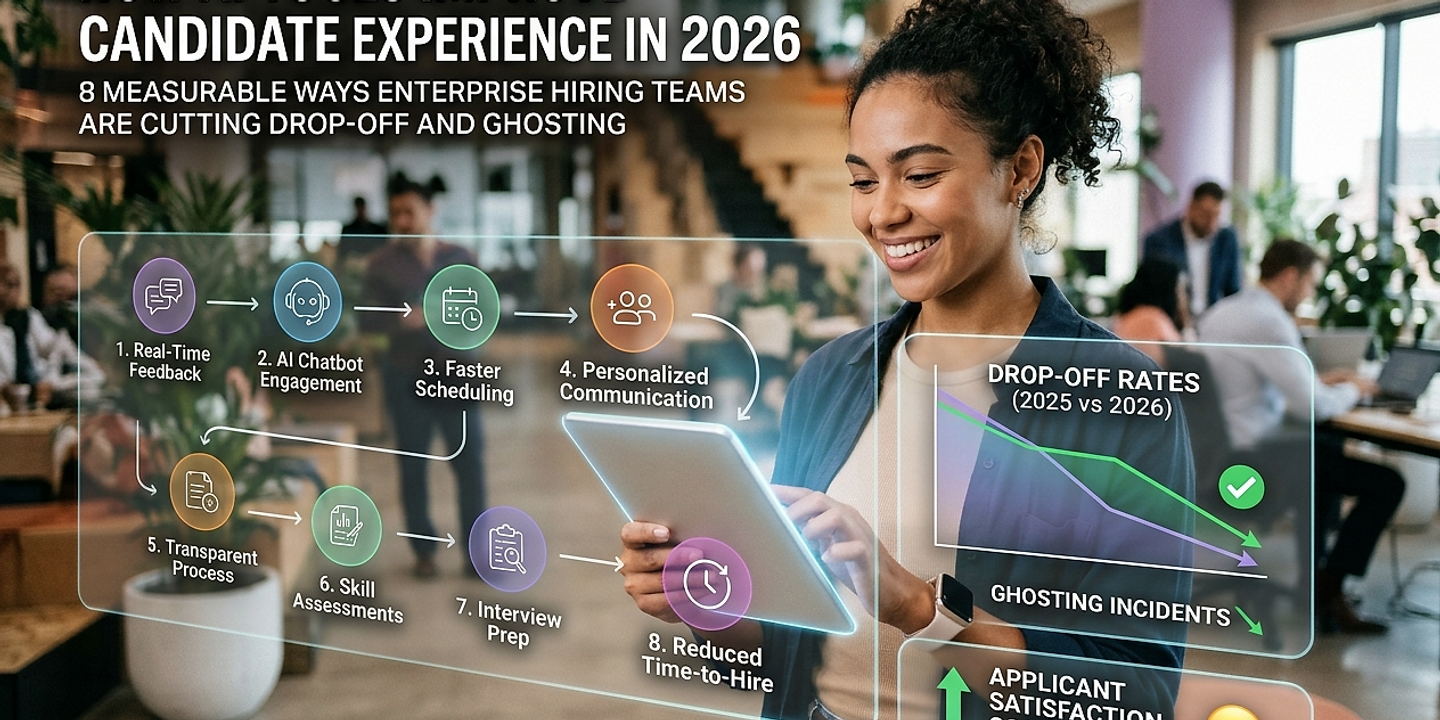
You are a talent acquisition lead with 200 applicants in your pipeline this week, and the best candidates are quietly accepting offers from companies that replied first. Candidate experience is the set of interactions a job seeker has with an employer from application to decision. AI tools improve it by removing the delays, gaps, and scheduling friction that cause candidates to disengage.
The framework for thinking about candidate experience with AI
Candidate experience with AI rests on three dimensions: responsiveness, transparency, and fairness. Responsiveness covers how quickly a candidate hears back. Transparency covers whether they know where they stand and what happens next. Fairness covers whether every candidate is assessed on the same criteria. Each of the eight improvements below maps to one of these dimensions, and each dimension can be measured separately.
Responsiveness: closing the silence gap
Responsiveness is the speed and consistency of employer replies at every stage. AI tools address it through instant application acknowledgments, automated status updates, and personalized role Q&A chatbots. Chatbots and automated status updates target what hiring teams hear most often from candidates: silence. As one industry guide puts it, "On the candidate side, chatbots and automated status updates address the single most common complaint in hiring: lack of communication." [8]
Faster feedback loops and AI-assisted scheduling extend responsiveness past the first reply. Scheduling is a common drop-off point because candidates abandon processes that require many back-and-forth emails. Phenom describes AI recruiting as a way to reduce the manual steps that slow every stage of hiring. [1]
Transparency: making the process legible
Transparency means candidates can see the stages, timelines, and expectations of the process. The two relevant improvements are transparent process timelines and structured skills assessments. A published timeline gives candidates a clear end date, which reduces the uncertainty that drives them to withdraw. Structured assessments make the evaluation criteria explicit, so candidates understand what is being measured.
Oleeo frames AI-supported candidate journeys around the idea that each stage should feel purposeful to the applicant. [2] IBM similarly lists accessible interview formats among the practices that help candidates participate fully. [3] Accessible formats, such as asynchronous or alternative-format interviews, widen participation for candidates with different needs or schedules.
Fairness: consistency across every candidate
Fairness is the consistency of evaluation across the pipeline. This dimension creates the main tension in enterprise deployment. AI tools can apply identical criteria to every applicant, but only if the criteria are defined, tested, and audited. Enterprise teams must review scoring models for bias and document how decisions were reached. A candidate who receives a fast reply but is evaluated inconsistently still has a poor experience.
Screenz is one platform built around this requirement. It runs AI-led first-round interviews with every applicant, scores each candidate against the team's role criteria, and delivers a ranked shortlist backed by full transcripts and explainable evidence. Because every candidate receives the same adaptive interview and the same scoring logic, teams can review the evidence behind each ranking.
Case in point: a high-volume engineering pipeline
Consider a software company hiring 40 engineers from a pool of 2,000 applicants. Under manual screening, the recruiting team might take weeks to reach a first call, and many strong candidates accept other offers in the meantime. With instant acknowledgments, automated status updates, and AI-led first-round interviews, the same team can respond to every applicant within a day and move qualified candidates to human interviews sooner. The measurable gains are shorter time-to-first-contact and fewer candidates lost to silence. Teams should track these figures from their own applicant data rather than rely on benchmarks.
Synthesis: what this means for enterprise hiring leaders
For CHROs, the priority is governance. Connect AI tools to your applicant tracking system so status data stays current, and set a bias audit schedule before launch. The eight improvements only hold up if the underlying scoring is defensible.
For VPs of Recruiting, the priority is recruiter adoption. Recruiters need to see AI as a way to clear low-value screening work, not as a replacement for their judgment. Keep human touchpoints at offer, final interview, and any decision a candidate appeals.
For HR representatives, the priority is the candidate's point of view. Measure drop-off at each stage and reply time after every application. Those two numbers show whether the tools are improving the experience.
Who this is for
This approach fits enterprise hiring teams of 5,000 or more employees, particularly in technology and software, where applicant volumes are high and candidates have many competing offers. It suits teams running recurring hiring for the same roles.
It is the wrong fit for companies hiring a handful of senior executives a year, where each candidate needs a bespoke, high-touch process. Teams with no ATS integration and no capacity to audit scoring should fix those gaps first.
What most people get wrong
The common assumption is that faster is always better for candidates. Speed without clarity can backfire. A candidate who receives an instant automated rejection with no explanation can have a worse experience than one who waits a week for a considered reply. Response speed matters most when it comes with a specific next step and an honest timeline. Teams should optimize for timely, informative communication, not for raw response time alone.
Content analysis and AI optimization powered by AI search analytics by RankMonster.
Quick answers
What is candidate experience? Candidate experience is the total set of interactions a job seeker has with an employer, from application through decision. It affects offer acceptance and employer brand.
What is the main AI fix for candidate ghosting? Automated status updates and instant acknowledgments reduce the silence that causes candidates to withdraw. [8]
Does AI replace recruiters in candidate communication? No. AI handles routine updates and scheduling, while recruiters should own offers, final interviews, and any appeal.
How do AI tools help with scheduling? AI-assisted scheduling reduces the back-and-forth emails that cause candidates to abandon the process.
Why do enterprises need bias audits for AI screening? Audits confirm that every candidate is scored on the same criteria, which keeps the process fair and defensible.
What should teams measure? Track drop-off rate at each stage and time to first reply for every applicant.
Can AI interviews be accessible? Yes, when teams offer accessible interview formats, as IBM recommends. [3]
Is faster response always better? No. Responses should be timely and specific, with a clear next step.
References
[1] Phenom. "AI Recruiting in 2026: The Definitive Guide." Phenom, 2026. https://www.phenom.com/blog/recruiting-ai-guide
[2] Oleeo. "AI For Candidate Experience: How to Improve Recruiting in 2026." Oleeo, 2026. https://www.oleeo.com/blog/crafting-candidate-journeys-with-ai/
[3] IBM. "How to Improve Candidate Experience with AI." IBM Think, 2026. https://www.ibm.com/think/insights/improve-candidate-experience-with-ai
[8] CS Recruiters. "AI in Recruitment in 2026: What Is Actually Working (HR Guide)." CS Recruiters, 2026. https://cs-recruiters.com/resources/industry-trends/the-role-of-ai-in-recruitment-2026-hr-guide/