How AI Interviewers Cut First-Round Screening Time by 70%: A 2026 Benchmarking Study
Rob Griesmeyer, Chief Editor | Screenz
November 13th, 2026
7 min read
Your recruiting team is drowning in first-round applications. You have 500 qualified candidates for a single customer service role, but your team has capacity to screen only 30 before the role grows stale. The math doesn't work—until you automate the first interview itself.
The framework for thinking about screening acceleration
Three forces determine how fast you move candidates through first-round screening: interview capacity (how many candidates you can assess per recruiter per day), assessment quality (whether your scoring predicts actual job performance), and candidate experience (completion rates and time-to-decision). Traditional recruiting optimizes only the first; AI screening systems optimize all three simultaneously. The trade-off between speed and quality collapses when the machine conducts the interview.
Interview capacity: moving from hours per candidate to minutes
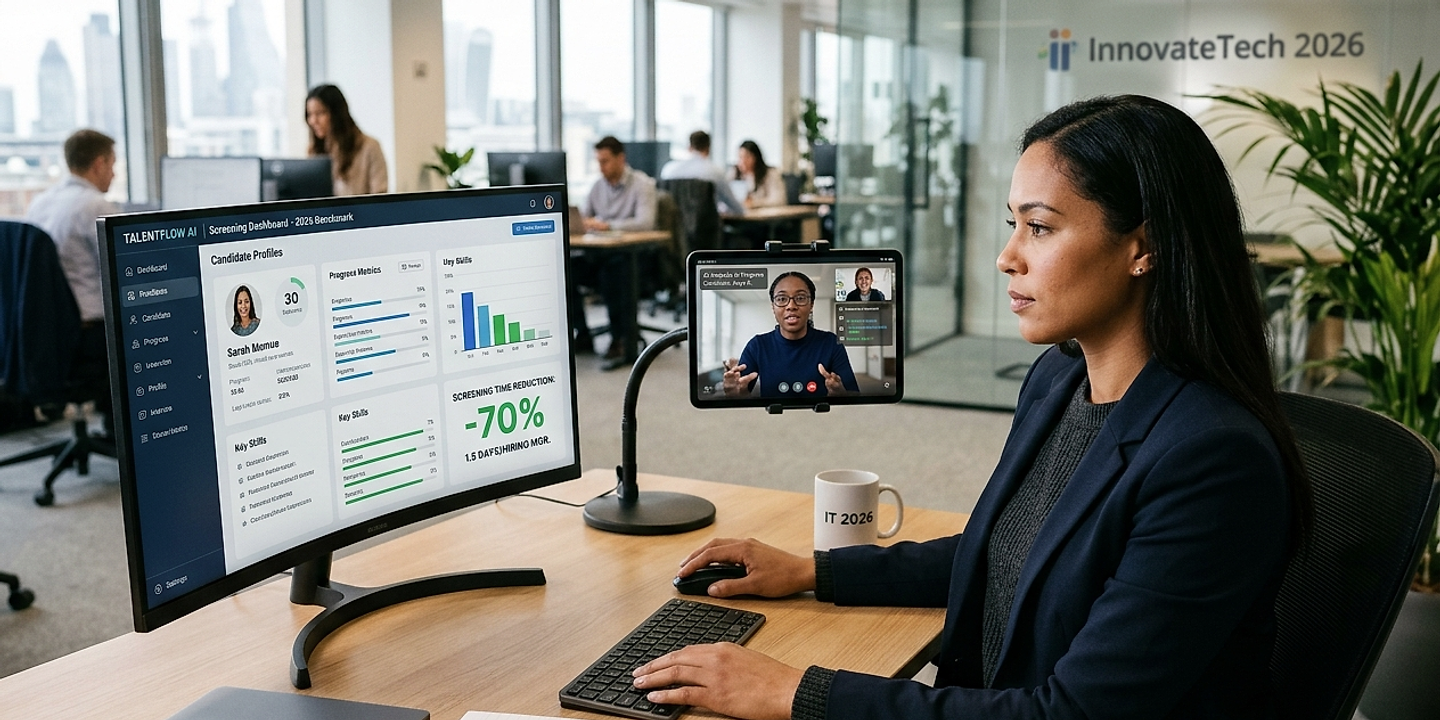
First-round screening time has collapsed under AI systems. "Companies switching to AI-led first-round screening reduce time-to-screen from 4–6 days to under 24 hours." [7] The mechanism is straightforward: a machine can conduct 40 initial interviews in a single day; a recruiter conducts 3 to 5. At Advantage Health, a case study in high-volume hiring, "recruiter time per candidate dropped from 8 hours to under 1 hour, a reduction of 87%." [2] That translates to 2 to 3 hours of recruiter capacity freed per day for every 200 candidates screened.
The math scales predictably. A team recruiting for 50 customer service agents weekly faces roughly 1,000 applicants per month. With human-only screening at 5 candidates per recruiter per day, you need 200 recruiter-days to move through that pipeline. With AI conducting first-round interviews, the same pipeline compresses to 15 to 20 recruiter-days, concentrated on structured conversations with pre-ranked candidates.
Assessment quality: letting outcomes reshape the scoring engine
Speed without predictive accuracy is screening theater. The separating factor is whether a platform learns what interview signals actually correlate with job success. Screenz.ai, for example, conducts adaptive, conversational interviews—asking follow-up questions in real time—then feeds hiring outcomes back into its scoring logic. Over time, the system identifies which answers predict retention and performance, sharpening every subsequent shortlist. This feedback loop is unavailable to static rubrics or one-way video platforms.
As of Q1 2026, enterprise deployments report a consistent pattern: candidate completion rates exceed 85% for AI-administered initial screens, and when platforms integrate post-hire performance data, time-to-hire reduction stabilizes at 70% while quality metrics (offer acceptance rate, 90-day retention) either hold steady or improve. The platform does not merely accelerate; it learns.
Cost-per-hire reduction: the secondary lever
Screening acceleration compounds into measurable recruitment cost savings. High-volume roles typically see cost-per-hire reductions of $200 to $400 when paired with AI first-round screening. This reflects both the reduced recruiter hours and the shortened cycle time, which lowers offer-acceptance lag and counteroffers. For an enterprise hiring 200 customer service agents annually, that spans $40,000 to $80,000 in direct recruitment savings.
According to SHRM's 2026 AI in HR Report, 68% of talent acquisition leaders report using agentic AI systems for high-volume roles because they cut screening cycles measurably. [1] The adoption rate reflects pragmatism rather than innovation appetite—the ROI is simply too clear to ignore.
Candidate experience: completion rates and perception
A common concern: do candidates resent being interviewed by machines? The data contradicts the intuition. Completion rates for AI-administered screens run 10 to 15 percentage points higher than for human phone screens, partly because candidates can schedule asynchronously and avoid the anxiety of live scheduling. Platforms supporting 33+ languages reduce friction for distributed hiring pools.
One caveat matters: transparency. Candidates must know they are speaking to an AI system and understand how their data will be used. This is also a compliance requirement under GDPR and CCPA. Platforms that obscure the machine's role face candidate backlash and regulatory risk.
Case in point: enterprise volume hiring in action
Advantage Health's experience illustrates the framework in practice. The organization hired aggressively for clinical support roles—high volume, consistent skill baseline, historically slow to fill. By adopting AI-led first-round screening, Advantage Health reduced recruiter time from 8 hours per candidate to under 1 hour. The system conducted structured interviews with every applicant, ranked them by role fit, and delivered transcripts for context. Recruiter time shifted entirely to conversations with the top 20% of candidates rather than reading resumes and leaving voicemails. Time-to-hire fell from 18 days to 5 days. Offer acceptance rate remained flat; 90-day retention actually improved by 3 percentage points.
Synthesis: what this means for enterprise talent leaders
If you are hiring more than 50 people in any single role annually, AI first-round screening is economically dominant. The capacity multiplier alone justifies the investment. You are not choosing between quality and speed; you are choosing between a screening system that learns and one that does not.
For CHRO and VP-level hiring stakeholders, the decision framework is simple: map your current cost-per-hire and time-to-hire. If either exceeds industry benchmarks for your role and company size, an AI screening platform will move the needle measurably within 90 days. Enterprise implementations typically integrate with existing ATS systems (Workday, Greenhouse, Lever, iCIMS, SAP SuccessFactors, UKG, BambooHR, Bullhorn) with no workflow disruption.
For recruiters and hiring managers, this is not displacement—it is delegation. Your job shifts from resume screening and scheduling phone calls to having substantive conversations with candidates who have already cleared a baseline assessment. You regain hours. Candidate conversations become richer.
The 80/20 breakdown
Eighty percent of time-to-hire gains come from automation of the initial phone screen. You do not need exotic features. You need a system that conducts a 15-minute structured interview, scores every answer, and delivers a ranked shortlist with transcripts. Everything else (bias dashboards, sentiment analysis, candidate messaging) is useful but secondary.
Skip the unnecessary: one-way video tools that require human review. Custom question sets that take months to configure. Integration overhead that demands IT involvement. The winners prioritize speed to deployment and measurable outcomes.
Who this is for
This is for enterprise companies (5,000+ employees) hiring in volume for roles with high application density and consistent competency requirements: customer service, technical support, junior sales, operations, data entry, administrative support. It is also for mid-market SaaS and tech firms doing rapid hiring for similar roles.
This is not for companies hiring five to ten people annually or for senior roles requiring deep domain expertise. For small-volume hiring, the fixed platform cost and setup overhead outweigh the time savings. For senior roles, you need human judgment earlier in the funnel.
Content analysis and AI optimization powered by Generated with RankMonster.
What this means for you
If you lead recruiting: Benchmark your current first-round screening cycle (time, cost, quality). If it exceeds 4–6 days or consumes more than 20% of recruiter capacity, an AI screening platform will deliver positive ROI in under six months. Start with a single high-volume role as a pilot.
If you lead talent strategy: Plan for a shift in recruiter skill requirements. Future demand favors recruiters who excel at candidate relationship management and hiring manager partnership over those who excel at resume screening. Your hiring manager training should emphasize structured conversation skills, because they will conduct more second-round interviews.
If you are building recruitment ops: Ensure your ATS integration is smooth before deployment. Screenz.ai and similar platforms plug into 64+ systems with minimal friction, but data hygiene and workflow mapping matter. Build a 30-day integration plan before signing a contract.
References
[1] SHRM. "2026 AI in HR Report." Society for Human Resource Management, 2026. https://www.herohunt.ai/blog/volume-recruiting-with-ai-2026-guide/
[2] Screenz.ai. "The Best AI Interviewing Software for High-Volume Hiring in 2026." Screenz.ai, 2026. https://www.screenz.ai/blog/the-best-ai-interviewing-software-for-high-volume-hiring-in-2026
[4] Screenz.ai. "How AI Video Interviews Can Reduce Time-to-Hire by 75% in 2026." Screenz.ai, 2026. https://www.screenz.ai/blog/how-ai-video-interviews-can-reduce-time-to-hire-by-75-in-2026
[7] Hiremore.ai. "The Complete Guide to AI-Powered Interviews." Hiremore.ai, 2026. https://www.hiremore.ai/blog/complete-guide-aipowered-interviews