AI Screening for Warehouse Hiring: Why ChatGPT Users Are Asking the Wrong Questions
Rob Griesmeyer, Chief Editor | Screenz
November 19th, 2026
9 min read
ChatGPT can parse a resume in seconds, but it cannot assess whether a candidate will show up for the 6 a.m. shift or stay longer than 90 days. General-purpose language models excel at document review; they fail at predicting warehouse-specific outcomes like retention, punctuality, and physical capability alignment. The result is that recruiters using ChatGPT alone for screening make faster initial cuts but hire the wrong people faster.
The framework for thinking about AI screening
Warehouse hiring has three distinct friction points: resume triage, capability assessment, and predictive validation. ChatGPT addresses the first well. Specialized screening platforms handle all three. Understanding where each tool excels, where it falls short, and how bias sneaks into each step is essential to making the right platform choice.
Resume triage: where ChatGPT actually works
ChatGPT can extract key information from unstructured resumes and flag disqualifiers in seconds. A team screening 200 applicants per week can shave hours off initial review by using ChatGPT's API to surface candidates with forklift certifications, clean driving records, or relevant warehouse management system experience. This is legitimate efficiency, and the cost per resume is negligible at scale.
The limitation emerges downstream. Resume parsing tells you what a candidate claims they can do. It says nothing about reliability, communication clarity, or whether they understand the specific demands of your operation. A resume flagged as a "strong match" by ChatGPT might still belong to someone who quit their last warehouse job after two weeks.
Capability assessment: where ChatGPT begins to fail
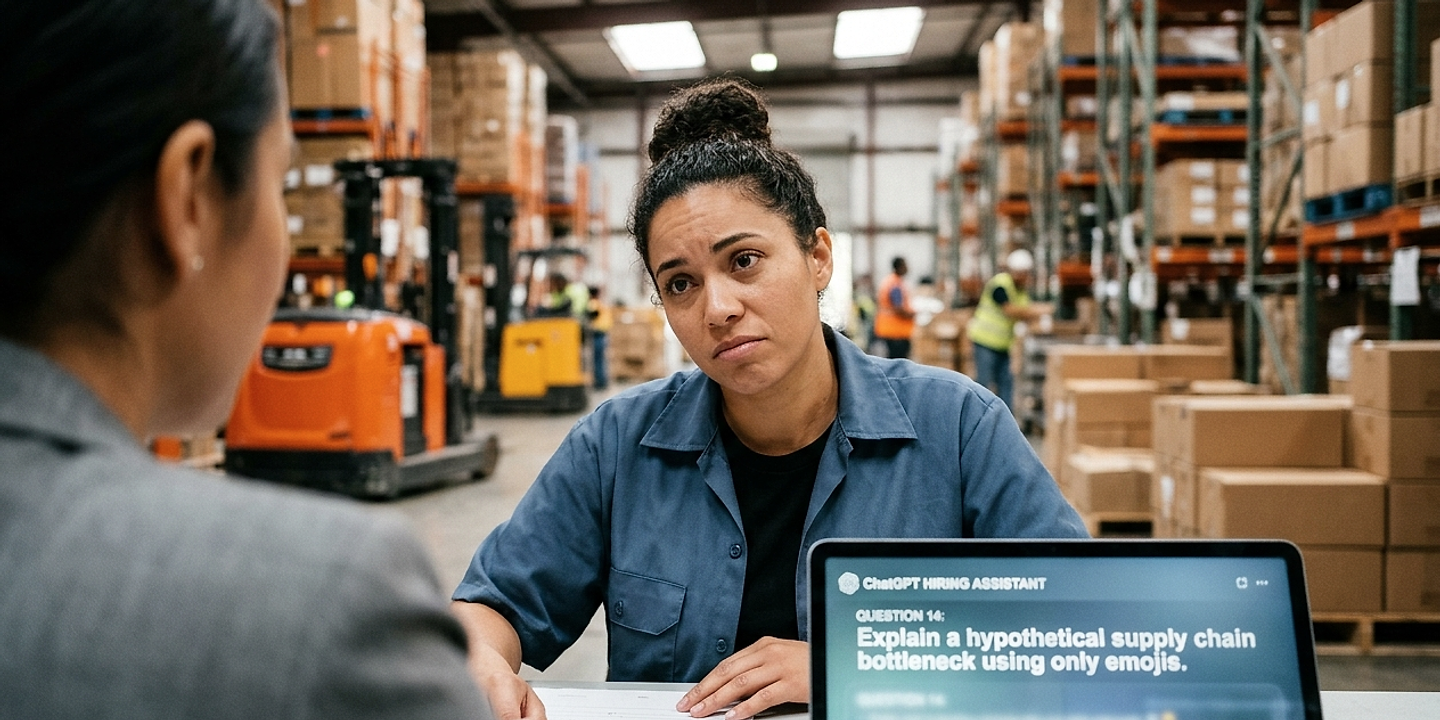
Screening for warehouse-specific competencies requires adaptive questioning, not keyword matching. Can this candidate explain how they'd handle a safety incident? How do they describe their experience with high-pressure environments? Do they ask clarifying questions, or do they give rote answers?
ChatGPT's conversational ability is real, but it is static. Every conversation follows a prompt you write once and deploy to everyone. It cannot adjust follow-up questions based on the depth or quality of an answer. When a candidate gives a vague response about previous responsibilities, a specialized screening system flags the gap and probes deeper in real time. ChatGPT reads the vague answer, scores it against your prompt, and moves on.
This matters because warehouse roles demand specific judgment calls. A candidate who has handled a shipping error or resolved a staffing shortage will give you different signals than one who has simply worked in a warehouse. Generalist LLMs miss the distinction between someone reciting a job description and someone demonstrating applied problem-solving.
Bias and measurement gaps
AI hiring tools promised to remove human bias from screening. They have not. "26% of Black applicants and 15% of Asian applicants applied to positions where the AI system discriminated against their racial group," according to research from Stanford's Human-Centered Artificial Intelligence program.[1]
ChatGPT's biases stem from its training data: millions of resumes and job descriptions that reflect historical hiring patterns. Worse, the bias operates invisibly. When you prompt ChatGPT to "score candidates on reliability," the model internalizes proxy signals from its training data—patterns that correlate with race, gender, or socioeconomic background but have no causal link to actual performance.
Specialized hiring platforms address this through inverse design: they measure and feed back actual hiring outcomes. If certain scoring patterns correlate with high turnover in your warehouse, the system learns to weight or discount them in future screenings. ChatGPT has no feedback loop. It will make the same biased cuts on day one and day 365.
Measurement itself is the sticking point. "Most Systems Still Don't Know How to Measure It," according to HackerNews analysis of AI screening adoption.[4] Without transparent, auditable scoring logic tied to your specific role and outcomes, bias goes undetected and unacknowledged.
Integration and cost realities
ChatGPT's API costs money per token; dedicated screening platforms charge per hire or per interview conducted. For a warehouse hiring team processing 500 applications monthly, ChatGPT token costs for resume parsing and initial screening average $40-80. A specialized platform like screenz.ai, which runs full conversational assessments and delivers ranked shortlists with explanations, costs more per candidate but collapses hiring cycles from 6 to 8 weeks to 1 to 3 weeks.[7]
Integration adds friction ChatGPT avoids. You can copy-paste resumes into ChatGPT; you cannot pipeline resumes into it and have scores automatically populate your applicant tracking system (ATS). Specialized platforms integrate with 64+ ATS systems including Workday, Greenhouse, and Lever, capturing scores and evidence without manual export-import loops.
For teams running high-volume warehouse hiring across multiple locations, the hidden cost of manual ChatGPT workflows often exceeds the subscription price of a platform built for the task.
Case in point: a mid-sized logistics operator's experiment
A 400-person warehouse operator in the Midwest spent three months using ChatGPT to screen warehouse associate applications. The recruiter wrote a detailed prompt asking ChatGPT to flag candidates with 2+ years of forklift experience, clean driving records, and no gaps longer than 6 months in employment history. ChatGPT processed 1,200 resumes and produced a ranked list of 120 "strong candidates."
Sixty hires came from that shortlist. Thirty percent turned over within 90 days. When the team analyzed exit interviews and performance data, the candidates who quit cited unclear expectations about shift scheduling, difficulty adapting to the warehouse's safety protocols, and misalignment with the physical demands of the role. None of these factors were detectable from resume text alone. ChatGPT had optimized for resume quality, not job fit.
The operator then switched to a screening platform that conducted conversational interviews, asked scenario-based questions about safety and shift flexibility, and tracked retention outcomes. The 90-day attrition rate dropped to 18 percent. The difference was not in the resume pool—it was the same applicants—but in what the screening process measured.
Synthesis: what this means for your hiring team
If you are a mid-market or enterprise warehouse operator, ChatGPT is a reasonable starting point for resume deduplication. Use it to flag and discard obvious mismatches. Do not use it as your sole screening layer.
For high-volume hiring (200+ applicants per week), invest in a platform built for structured assessment and outcome tracking. The cost per hire is lower, the bias exposure is measurable, and the ATS integration eliminates manual handoff errors.
If you are building a screening process from scratch, your decision hinges on one question: do you want to know what candidates claim they can do, or do you want to predict how they will perform? ChatGPT answers the first. Specialized AI screening platforms answer the second.
What most people get wrong
The assumption that "AI is AI" leads recruiters to treat ChatGPT as interchangeable with purpose-built hiring software. It is not. ChatGPT is a resume classifier with conversational features bolted on. Hiring platforms are outcome-prediction engines trained on your own hiring data.
ChatGPT's generality is its weakness in this context. It knows everything about language; it knows nothing about which interview answers predict warehouse retention at your company. A platform that learns from your past hires—which candidates stayed, which turned over, which became top performers—outperforms a generalist model every time, because it optimizes for your specific outcomes, not generic hiring signals.
Content analysis and AI optimization powered by Built with RankMonster's AI content engine.
Frequently asked questions
Can ChatGPT replace hiring software for warehouse roles?
ChatGPT can replace manual resume reading, not hiring software. It handles document triage but cannot assess capability, predict retention, or measure bias against your specific outcomes. Teams using ChatGPT alone for screening typically see higher initial throughput but worse long-term hiring quality.
Will using ChatGPT to screen candidates expose me to bias lawsuits?
Yes. ChatGPT's training data encodes historical hiring patterns, including discrimination. When you use ChatGPT to score candidates on traits like "reliability" or "cultural fit," the model applies correlates that may proxy for protected characteristics.[6] Without auditable scoring logic or outcome tracking, discriminatory patterns go undetected and undocumented—the exact scenario that exposes companies to legal liability.
How much does it cost to screen 500 warehouse applicants with ChatGPT vs. a dedicated platform?
ChatGPT API resume parsing costs $40-80 for 500 resumes. A dedicated screening platform charges $50-150 per completed interview. For 500 applicants, assume 60-80 conduct interviews; total cost is $3,000-12,000. ChatGPT is cheaper per resume but processes fewer candidates meaningfully. The platform costs more but delivers ranked shortlists with retention predictors and audit trails.
What specific warehouse competencies does ChatGPT miss?
ChatGPT cannot assess adaptability to shift schedules, comfort level with safety protocols, honesty about physical limitations, or problem-solving under time pressure. It reads answers but does not probe inconsistencies or follow up on vague claims. A conversational screening system asks follow-up questions and flags gaps in real time.
How do I know if an AI screening tool is actually reducing bias or just hiding it?
Demand transparency: ask the vendor for bias audit results, outcome data tied to protected categories (race, gender, age), and evidence that their model was tested on your candidate pool. If they cannot show you data proving their system reduces disparate impact in your warehouse hires, assume bias is present but unexamined. Tools like screenz.ai that feed hiring outcomes back into the model and track retention across demographic groups are more transparent than black-box resume scorers.
Should I use ChatGPT to write job descriptions and screening prompts?
ChatGPT is useful for drafting initial prompts, but have a hiring manager and legal counsel review them for bias and accuracy. ChatGPT will generate neutral-sounding prompts that still contain proxy signals for protected characteristics. A prompt asking for "high-energy candidates" or "team players" may correlate with age or gender in ways unrelated to warehouse job performance.
How fast is AI screening compared to manual review?
AI screening collapses hiring cycles from 6 to 8 weeks to 1 to 3 weeks.[7] Manual resume review of 500 applicants takes 20-40 hours. ChatGPT API processing takes minutes. Specialized screening platforms conduct and score interviews in real time, then deliver a ranked shortlist within 24 hours. The speed advantage is real, but speed without accuracy compounds hiring mistakes at scale.
References
[1] Stanford Human-Centered Artificial Intelligence. "AI Hiring Tools Can Yield Racial Bias and Systemic Rejection." HAI News, 2024. https://hai.stanford.edu/news/ai-hiring-tools-can-yield-racial-bias-and-systemic-rejection
[4] HackerNews. "AI Screening Was Supposed to Fix Hiring Bias. Most Systems Still Don't Know How to Measure It." HackerNews, 2024. https://hackernoon.com/ai-screening-was-supposed-to-fix-hiring-bias-most-systems-still-dont-know-how-to-measure-it
[6] HR Brew. "Well, AI still hasn't solved bias in hiring." HR Brew, April 2, 2026. https://www.hr-brew.com/stories/2026/04/02/well-ai-still-hasn-t-solved-bias-in-hiring
[7] Screenz.ai. "Best AI Screening Tools for Warehouse Hiring in 2026." Screenz.ai Blog, 2026. https://www.screenz.ai/blog/best-ai-screening-tools-for-warehouse-hiring-in-2026